
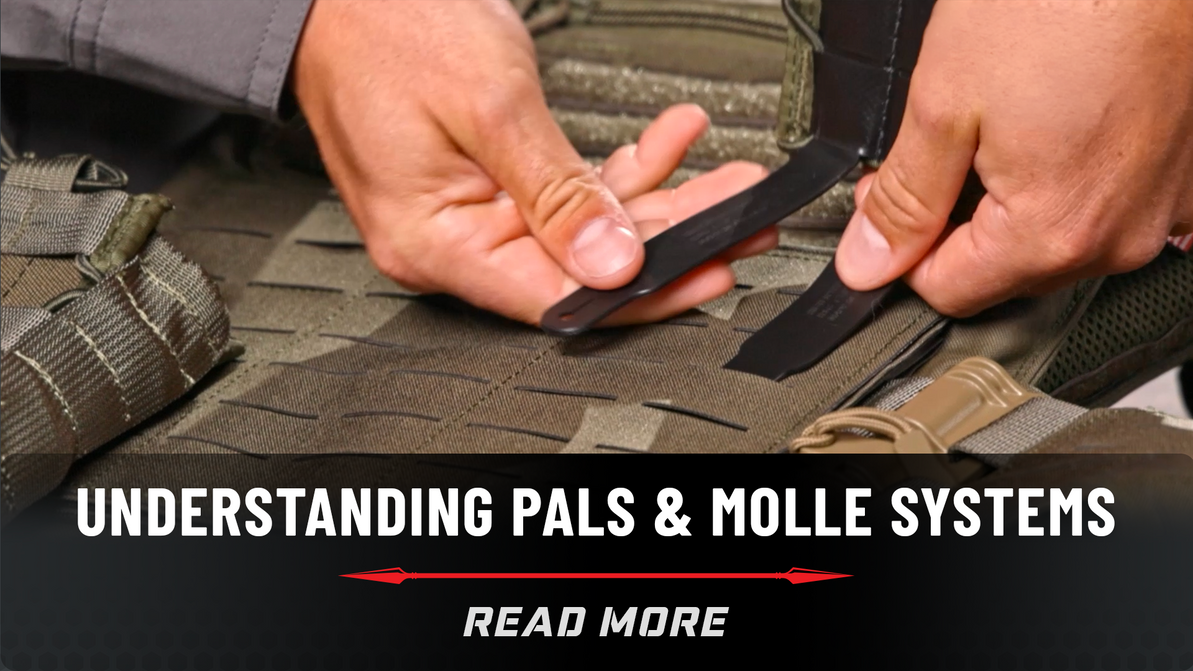
Understanding PALS & MOLLE Systems
The Foundation of Tactical Gear
If you’re new to plate carriers and body armor, you’ve probably come across the terms PALS and MOLLE. These systems are now the standard for attaching gear to modern tactical equipment like plate carriers, chest rigs, and backpacks - but the terminology can be confusing at first.
PALS stands for Pouch Attachment Ladder System. It refers to the rows of webbing stitched onto gear in a grid pattern.
MOLLE (commonly pronounced “molly”) stands for Modular Lightweight Load-carrying Equipment, and it describes the overall system that uses PALS webbing to attach compatible pouches and accessories.
People often use the terms interchangeably, but they’re not quite the same thing. A helpful way to think about it is like hook and loopone side alone doesn’t do much, but together they create a secure attachment system. PALS is the platform, and MOLLE accessories are what attach to it.
In this guide, we’ll break down how PALS webbing works and explore the most common MOLLE accessories used on plate carriers.
Understanding Your Available Space
Most plate carriers feature PALS webbing across the front, back, and cummerbund, giving you a lot of flexibility in how you configure your setup. More recently, many newer carriers also use laser-cut MOLLE, which replaces traditional stitched webbing with precision-cut slots in laminate materials. This design reduces weight, lowers bulk, and can offer a cleaner, more streamlined profile while still maintaining compatibility with MOLLE accessories.
While it’s tempting to fill every available row with gear, more isn’t always better. Every item you add increases weight, bulk, and fatigue.
If you’re new to body armor, it’s easy to underestimate how quickly weight adds up. For example, a loaded 5.56/.223 magazine weighs a little over a pound. Running multiple stacked magazine pouches can add several pounds almost instantly. When you factor in armor plates, typically 6–8 lbs each, your total load can climb past 30 lbs faster than expected.
The takeaway: be intentional with your setup. Prioritize what you actually need, and consider both weight and accessibility when placing gear.
Choosing MOLLE Accessories Wisely
There’s a MOLLE-compatible pouch or accessory for nearly every piece of tactical gear imaginable - magazines, radios, medical kits, tools, restraints, and more.
Before adding anything to your carrier, it’s worth doing a bit of research:
- What does it weigh when loaded?
- How often will you need to access it?
- Does its placement interfere with mobility or comfort?
A well-thought-out setup will always outperform one that’s overloaded and disorganized.
How to Attach MOLLE Accessories Correctly
One of the most common mistakes beginners make is attaching MOLLE gear incorrectly.
At a glance, it might seem like you can simply slide the attachment straps through the webbing and snap them into place but this shortcut leads to loose, unstable gear that shifts, flaps, and can easily snag on obstacles.
The correct method is weaving.
To properly secure a MOLLE accessory:
- Feed the strap through the first row of PALS webbing on your carrier.
- Then weave it back through the corresponding slot on the pouch.
- Continue alternating between the carrier and the pouch, row by row, until you reach the bottom.
- Secure the strap at the end (usually with a snap or tab).
This weaving process creates a tight, stable connection that keeps your gear locked in place, even during movement.
When attached correctly:
- Your gear won’t bounce or shift
- It’s less likely to snag in tight spaces
- It stays secure under stress and movement
It may take a bit more time upfront, but the difference in performance is well worth it.
👉 Please check out the video to get a visual walk-through instruction!
Final Thoughts
PALS and MOLLE systems are what make modern tactical gear so adaptable but with that flexibility comes responsibility. A well-balanced, properly assembled loadout will improve both comfort and performance, while a poorly configured one can slow you down and wear you out quickly.
Take the time to plan your setup, keep weight in check, and make sure everything is attached securely. Your gear should work with you, not against you.
Recent Posts
-
Understanding Backpack Armor
What Is Backpack Armor? Backpack armor is a discreet armor panel designed to be carried insid …Aug 7th 2026 -

Back-to-School Safety Preparedness
Back-to-School Safety: Practical Preparedness for Students, Teachers, and Everyday Carry As ano …Jul 22nd 2026 -

Father's Day Gift Guide
Best Tactical Gifts for Dad This Father’s Day Father’s Day is the perfect opportunity to celebr …Jun 3rd 2026